Showing posts with label Quilting in Fredericksburg. Show all posts

Saturday, July 5, 2014

History of Quilts in America - Happy 4th of July!!!

Unfortunately, I didn't have time to actually research this myself, but when I Googled "History of Quilts" I found this wonderful site:  http://www.quilting-in-america.com/History-of-Quilts.html


The history of quilts began long before European settlers arrived in the New World. People in nearly every part of the world had used padded fabrics for clothing, bedding, and even armor. With the arrival of the English and Dutch settlers in North America, quilting took on a new life and flourished.

The term "quilt" comes from the Latin <i>culcita</i>, meaning a stuffed sack.  The word has come to have 2 meanings. It is used as noun, meaning the 3-layer stitched bedcovering. It is also used as a verb, meaning the act of stitching through the 3 layers to hold them together.
A quilt is a cloth sandwich, with a top, which is usually the decorated part, a back, and a filler in the middle. Under the general term of patchwork are of 3 different types of quilts: (1) the plain or whole cloth quilt, (2) applique quilts, and (3) pieced or patchwork quilts.
The quilt, as we know it in America, was originally a strictly utilitarian article, born of the necessity of providing warm covers for beds. Quilts were also used as hangings for doors and windows that were not sealed well enough to keep out the cold. The earliest American quilts, made by English and Dutch settlers, were so intimately connected to everyday life of the early colonists that no record of them exists.


During the early years of American colonization, most Colonial women were busy spinning, weaving and sewing the clothes for their family, so had little time for artistic quilting. Commercial blankets or woven coverlets were more likely to be used, but during difficult times, when money was scarce or imported textiles limited, many Colonial women had to become creative in their use of materials on hand to keep their families warm during the cold seasons.
Those early settlers could not afford to simply discard things when they wore out; necessity required they carefully use their resources. Therefore, when blankets became worn, they were patched, combined with other blankets, or used as filler between other blankets. These were not carefully constructed heirlooms, rather they were functional items for the sole purpose of keeping people warm. Only in later years, when fabrics were being manufactured in America and were more affordable, freeing women from the work of making their own yarns and fabrics, did the more artistic type of quilting become more widespread.
In the 100 years between 1750 and 1850 thousands of quilts were pieced and patched, and many of them are preserved. Many of these quilts were so elaborate that years were spent making and quilting them. It is no wonder they are cherished as precious heirlooms and occupy honored places in homes and museums. Those early quilts provide a glimpse into the history of quilting as well as the history of the United States.

Whole cloth quilts, broderie perse and medallion quilts were popular styles of quilts made during the early 1800s. The whole cloth quilt, also known as counterpane, is usually made of single pieces of material on the top and back, and the decoration is obtained by means of padded or corded quilting in more or less elaborate design.
The applique quilt, or "laid-on" quilt, usually has a top made of whole cloth with smaller pieces of contrasting fabrics cut into shapes or forms that are applied or stitched down. These quilts were considered more elegant than the humble pieced type. Applique for quilting came into favor around the mid-1700s and reached its climax about 1850. Only the wealthy could afford the expensive imported fabric and had the leisure time for this type of quilt making that displayed the fine needlework of the maker.
The earliest settlers had no labor or materials to spare so they typically found the simplest, most expedient solutions to problems. This focus on functionality was exhibited in their architecture, tools and household furnishings, as well as political and social institutions. The block-style pieced quilt was an example of this functional approach to design. Once again, the history of quilts mirrored that of the developing country.
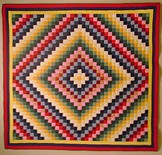
In the early 1700s Amish colonists began settling in the rich farmlands of Pennsylvania and the Midwest. They emigrated from Europe with the hope that they would be able to have the freedom to live according to the principles of their religion. Those early Amish women did not quilt, rather using the featherbeds traditionally used in Europe. Over time, contact with outsiders combined with necessity, Amish women began creating quilts with the characteristic beauty and craftsmanship that are the hallmark of Amish quilts.


As the frontier was conquered, living conditions improved. With prosperity and the availability of more materials, quilts became less austere. The patchwork quilt was a "utility" quilt, in contrast to the applique quilt which was a "best" or show quilt, upon which time and material was lavished.
A particularly popular style of quilt in the early days of quilting (through the early 1800s), was the Medallion quilt, which was made in a style that had actually been brought to America from Europe by the colonists. This type of quilt -- a central motif surrounded by multiple borders -- offered endless design possibilities for quilters, who could use patchwork, applique, embroidery, either alone or in combination.
Though there are examples of elaborate patchwork quilts that took enormous amounts of time to make, pieced quilts were generally the everyday bedcover, and designed to be made quickly. Since even small cloth remnants could be used in patchwork quilts, every scrap of fabric and usable portion of worn garments were saved and used in patchwork quilts. Pieced quilts became the most common type of quilt at that time.
A variation of the utility quilt was the plain "tufted" quilt that is tied through in enough places to keep the filling from shifting and bunching. While a tufted quilt has no stitching holding the layers together, it does have the typical 3 layers seen in traditional quilts. Another variation of the quilt is the "summer" quilt, which does not have the middle filling, so is useful as a bedcover during the warmer months. The summer quilt does have the traditional stitching holding the 2 layers together.
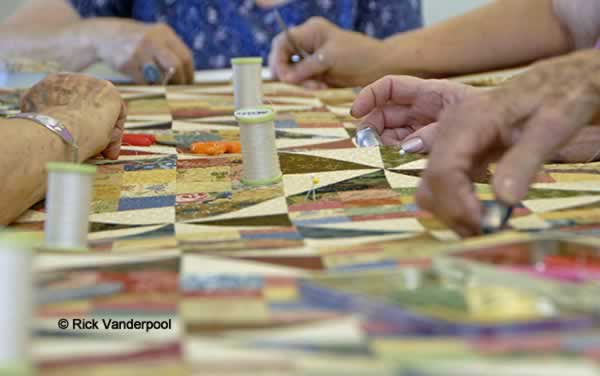
Members of rural communities frequently joined together to help their neighbors with big projects, such as barn building or finishing quilts. The quilting bee was a social event that allowed the finishing of several quilts in a single day instead of weeks or months.
Naturally, early quilters did not limit themselves to designing only quilts of a single type or method. They used their imagination and ingenuity to combine patchwork, applique, and embroidery in endless combinations. One early variation was the Medallion quilt, a relatively simple design with dramatic impact, that was particularly popular through the early 1800s.
During the 1800s in many parts of the country there was a custom that a young girl make a baker's dozen of quilt tops before she became engaged. This collection consisted of 12 utility quilts, undoubtedly pieced, and 1 great quilt, which was either a pieced or applique quilt, for her bridal bed. After her engagement, she would take final steps to turn her tops into finished quilts.
Another custom was for mothers to make several quilts for each of her children to have when they left home to start life as adults. A variation of this custom continues to this day as quilters continue to make heirloom quilts for their children or grandchildren.
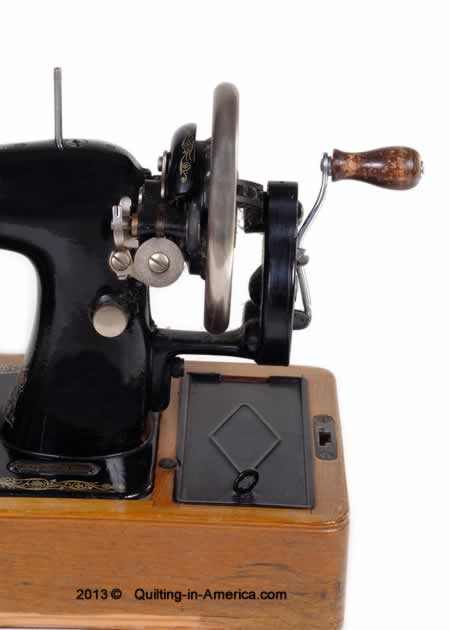
In the mid 1800s the introduction of the sewing machine somewhat altered the dependence on hand-sewing. Long before electricity became common, quilters could power a sewing machine with a foot treadle or hand crank. The invention of a separate quilting attachment for the sewing machine by Henry Davis of Chicago did not seem to be widely used; hand quilting remained the favored method for nearly a century.
Much of the handwork involved in quilting may have been a form of relaxation for pioneer women, a relief from the drudgery and real labor of family life on the frontier. Additionally, fine handwork was a source of pride and status.
As the frontier was conquered, living conditions improved. With prosperity and the availability of more materials, quilts became less austere. Patchwork quilts were more likely to be made of new and finer fabrics. Appliqué quilts, which require more fabric, began to emerge and developed a body of traditional patterns. More and more women, particularly those in the upper-classes, had the time and resources to pursue more "genteel" arts. During this time the Victorian crazy quilt, became popular. By the early 1900s, quilting was transforming from a necessary art into a creative one.
When the United States entered World War 1 in 1917, quiltmaking became more important than ever. The U.S. government urged citizens to “Make Quilts – Save the Blankets for our Boys over There.” Quilts were made for fundraising and awareness building. The government took all the wool produced for commercial use in 1918 and instituted “heatless Mondays.” Following the war interest in quilting as an art was renewed.
During the Great Depression, people simply did not have the money to buy blankets so once again women relied on their own skills and resources to keep their families warm. Saving bits and pieces of material from clothing and other blankets, using material from feedsacks, and "making do" were common practices for frugal quilters during those difficult years.
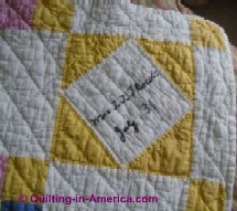
During World War 2, quilting was used to raise money to support the Red Cross. The “signature quilt” was especially popular. In a signature quilt, business people, store owners, and citizens of a community would pay a small fee to have their names embroidered on quilt blocks. The blocks were sewn together and quilted, and the finished quilt was raffled off with all proceeds going to the Red Cross. These quilts are now fascinating community records.
Through the 1950s and 1960s, there was less general interest in quilting than at any other time in American history. To many, the quilt was associated with lean times and “making do” – quiltmaking was viewed as dated and old-fashioned. It was primarily older quilters, those who had always quilted, who kept the art of quiltmaking alive during this time.
Then in the 1970s and 1980s, the granddaughters of these older women began to revive interest in quiltmaking. The back-to-the-land movement, prompted by the anti-materialism of the late 1960s, generated a desire among many young people to learn hand skills that had been neglected in the postwar rush toward an automated society.
A milestone in American history, the Bicentennial celebration of 1976, was also a turning point in the history of quilts in America. The quilt became popular as a means of expressing national pride and achievement, and a powerful reminder of our past.
Now, in yet another century, quiltmaking in the early 2000s is still practiced as it always was, though now more for relaxation than out of necessity. Some quilters follow the craft in conventional form for leisure-time amusement or because it represents a tradition they find emotionally significant. Others have found in quiltmaking an artistic medium they can manipulate to their ends, and have ultimately created new styles and techniques.
The history of America can be seen in the history of quilts: in the rich heritage left us by those thrifty, self-sufficient women who helped settle this land, in the families whose history is sewn into quilts one patch at a time, and in the legacy of the quilting arts passed on to children and grandchildren so they may carry them forward to the future.


There are many online sites with information about the heritage of quilting in America. Some are excellent, containing well-researched scholarly information, such as The International Quilt Study and Museum at the University of Nebraska - Lincoln.
Others, such as Block Central's Quilt Directory contain links to many fine sites that pertain not only to the history of quilts, but to other elements of quilting as well.


This site has a lot more wonderful information and I recommend that you visit it as soon as possible!  I thank them immensely for this information and am glad that this information is out there for our information as I find it fascinating!!!

Monday, January 27, 2014

Man Quilters!!!

So, there is something going on in quilting right now...it is not a completely new phenomenon, we have all heard of Ricky Tims -  http://www.rickytims.com/, and Jamie Wallen -  http://www.jamiewallen.com/jamiewallen/Welcome.html etc., but it seems to be going more mainstream!!!!  I discovered it this summer, right after I opened the new studio for Liz B. Quilting, when a man came in and asked me to quilt for him.  He was with his wife and just like a used car sales man, I kept trying to talk to her, so she let me know in no uncertain terms that it was HIS quilt and to talk to HIM!  Cool!  Especially when you see how his quilt looked...


I know right?!!!  It was his first quilt and not only is it crazy hard, but it is a signature quilt as well for one of his nieces...What???

At the Grand Opening of Liz B. Quilting new studio a man came in and said he was a quilter...I said great.  It was/is amazing because he is also a Vietnam Vet...he used to be a mason and now quilts to stay young in the mind!  He has since brought me probably 10 quilts, they are all huge and he donates them all to Wounded Warriors.  They are all his own designs (not that they are not already done, but he doesn't use a pattern, just figures it out).  Here are some of his latest creations...


Next thing you know a guy (who also came to the Grand Opening) comes in and wants to take the beginning quilting class...he takes and does such an AWESOME job!  He started to make a quilt for his Mother-in-Law's church...should have taken a picture of that when he was coming in for open sew.  Here is his beginning quilting class top...


Next thing you know another man shows up for my Spring Bed Runner Class with his wife...he finishes his whole bed runner in one after noon!  He then proceeded to go home and piece a crazy hard chain pattern that I can't seem to get off my phone.  He used strip piecing and chain piecing methods all by himself  What???


And then this morning...this one shows up!  This one was made by a retired Marine who has a mini museum in his basement and is going to put this on the bed down there...then, he is going to make his new grand-baby girl a pink one like this...What???  He designed it himself and even is letting me borrow the pattern (that he designed on Power Point) for my hubby's retirement quilt...(don't read this honey : D). 


As if that isn't impressive enough...he mitered his corners!!!


This is so exciting!  I am loving these Man Quilters!!!

Tuesday, December 31, 2013

A Christmas Blog

I know that I am woefully late with this blog, but it is such a great story I have to share no matter how late : D...

A few months ago I had a customer come in and ask if I could sew some blocks together for her.  I said, of course I would be happy to do it.  Then, she showed me the blocks...they were beautiful red, green, tan and cream sampler blocks.  They were very hard blocks to make...Dresden Plate, Tumbling Blocks, Appliqué Hearts, Grandmother's Flower Garden, Turkey Tracks - all the usual suspects...AND they were all hand pieced!  They were done very well with lots of room for seam allowance without losing ANY points.  We decided that they couldn't be just sewn together that they needed sashing and cornerstones...a few of the blocks were smaller than the others, so we would put frames around those to make them a little bigger...


So, I had to ask her what was the story of the blocks...and what she told me warmed my heart and I want to share the story with you.   

It turns out 20 years ago she had a very good friend and they started quilting together.  They had made these blocks together and these were her friends.  They were teachers together here in Stafford and her friend had been very meticulous about putting these blocks together.  She further explained that quilting wasn't her thing and she had since had 5 kids and here just wasn't time for her to do them. 

So, I asked her how did she end up with the blocks...she stated that her friend had passed away of cancer and that she had had these blocks for 19 years...and she wanted to get them put together and quilted to give it to one of their very good mutual friends.  This just warmed my heart and I couldn't wait to get started!  

Here is a picture of what it looked like when we it was finished.  She was thrilled and I am so happy to say that her friend loved it too!  She wrote to me afterward and let me know that her friend was very surprised and very happy to have it.  I love my job!!!


Sunday, November 10, 2013

Spa Treatment for Bella

A few weeks ago, it was time to do some maintenance on Bella (my 12' frame and 26' sew head with Autopilot).  I call this giving her the "Spa Treatment".  I love the Innova because it is so easy to do this "spa treatment" and it makes her so happy! 

First you get some rubbing alcohol and some cotton swabs...


Then you dip the cotton swab into the alcohol and wipe all the white wheels on the carriage...


Then, put some alcohol on a paper towel and wipe off the tracks on the carriage and the frame...

 
Then, wet a cotton swap with alcohol and wipe off the encoders...
 
 
You might notice that there is thread in your wheels (I had some after almost 3 years of use)...

 
You can easily take the wheels off by putting some books under your carriage, loosen the bolt (paying attention to the order that the bolt, washer etc. go together when you take it out) take out the bold and take off the wheel, to get the thread out.  Then, put the bolt assembly back together and tighten it back up.


If you have an autopilot, you might want to check where the belts go around the pulleys at the end and under the sew head...(be very careful not to pinch your fingers).  If you grab the thread and move the sew head it will come right out.

Bella is so very happy now!  However, the coolest thing is - even with all this thread in the wheel, and lint on the wheels, she still stitched beautiful!!! 

Sunday, October 20, 2013

Now AWESOME Quilt!

Awesome quilt!

Borders Done Right!!!

Ruffle borders after ...

Notice the picture of the borders in the previous post...

See how they ruffle...my customer did 4 borders and didn't measure 3X to get the average and then cut her borders to the correct size and pin them together from the middle out...and boy did they ruffle!

I had to give the quilt back and she was very gracious about fixing it and man what a difference.  She said she cut 42" off the borders...there are 4 borders that makes almost 3" off each one (there are 16 border pieces total). 

Her quilt is now AMAZING!!!  See latest post...  Woot woot!!

Borders...Gone Wavy!!!

Ruffle border before...

Thursday, October 17, 2013

Freezer Paper Applique Class at Liz B. Quilting!


Hi Everyone!

I am excited about our class this weekend on Sat Oct 19 from 10am – 4pm.  We are going to learn how to do Applique Quilting using the Freezer Paper Method.  This is a great way to make your applique come out great. 


If you are interested in learning how to Applique or you have tried this method before, but found it hard…I urge you to come to Liz B. Quilting at 2757 Jefferson Davis Hwy, Ste 117, Stafford VA 22554 for this class!  Ann Littleton is teaching this class and is a well-known quilting instructor here in Northern Virginia…here is some more information.

This is handwork, so no need to bring your sewing machine...see the supply list below.

About Ann Littleton -

 Ann is a graduate of James Madison University, with a BS in Elementary Education and Speech Pathology.  She’s been married since 1972, to Joe, a former Navy Pilot.  They have 4 grown children.

 Because of Joe’s ever mobile military career, and her commitment to raise “somewhat well adjusted” children,  Ann’s had many interesting part time jobs, including teaching preschool music for 6 years.  They made their final move to Stafford, VA in 2003.

 Ann began quilt design in 1986.  Articles and photographs of her quilts have appeared in various publications. Several quilts have appeared in national exhibits/ shows. As an experienced quilt teacher and speaker, Ann enjoys combining embellishments and vintage design, along with stories of the friendships of women in her quilts, trunk shows/programs, workshops and patterns.

 Ann’s memberships include Quilter’s Unlimited, Virginia Quilt Museum, Quilters Hall of Fame, Old Dominion Appliqué Society, and Baltimore Appliqué Society.  Other interests include premarital counseling, power boating, along with various volunteer activities.

  These are the supplies that you will need:

Beginning Hand Appliqué

Freezer Paper(Inside) Method

Taught by Ann Littleton

SUPPLY LIST

Template plastic (large sheet-at least 11 inches square)

Mini iron--1 inch x 7/8th  inch sole plate(Clover Needlecraft brand)

Fine line Sharpie marker

Mechanical pencil

Water soluble glue stick (Staples brand is good)

Reynolds Wrap brand freezer paper for crafting(at least 18 inches from a roll)

Fabrics: 100% cotton, pre-washed and ironed (make sure the dyes don’t run)

½ yd. background fabric

1 fat quarter(18in X 20in) fabric for circle(vine)

Assorted scraps of fabric for leaves and flower petals

Fine cotton thread to match leaf and petal fabrics, or silk thread (I like YLI #100 silk thread)

Appliqué needles--# 10 straw, milliner’s, or Jean Lyle needles(10A)

Needle threader if needed

Small sharp scissors for cutting fabric

Paper cutting scissors 

Straight pins

Blue painter’s tape

Bring a bag lunch 

Bring all your supplies and come prepared to have fun!


Sunday, October 13, 2013

More Modern Quilting at Liz B Quilting in Stafford - Pattern Available!

 Here is some more modern quilting at Liz B. Quilting...

Modern Quilting can be recognized by the modular pattern of the blocks, the non traditional placement of the pattern of the blocks and the use of solid or modern print fabric with geometric quilting. 

I am selling this pattern if you are interested...just let me know.

What do you all think about Modern Quilting?

Sunday, October 6, 2013

Modern Quilting at Liz B. Quilting!

And the back stitching!!!

This is the back...can you believe it? at Liz B. Quilting!

And the back!!!

Crazy AWESOME Modern Quilting at Liz B. Quilting!

Here is the stitching!!!!

So Cool, Modern Quilting at Liz B. Quilting in Stafford, VA!!!

Modern quilting at Liz B Quilting!!!

Monday, September 30, 2013

A Day of Rest


I taught a Custom Longarming Class on Sat., which was AWESOME and have a tendency to work all the time in order to accommodate the schedules of my customers...however,

I am feeling so GREAT this morning after a day of rest.  When you are starting your own business you have a tendency to work 7 days a week and 24 hours a day...(not literally, but you just never set your stress down). 

I did a puzzle with my son, went shopping with my family and took a nap : D...

I read an amazing article in my e-mail this morning from my wonderful Aunt about stress and relieving stress.  A woman stands with a glass in the front of a group and asks how heavy do you think this glass is?  Some said 8oz, some said 10oz etc.  She says - the actual weight doesn't matter, it is how long I hold it!  If I hold it for a few minutes that is ok, if I hold it for several days there is likely to be damage to my arms, nerves etc. 

Wow, this made perfect sense to me!  I have got to learn to set my stress down for a while now and then.  (My stress doesn't feel like stress most of the time, but I think it wears on me after a while...I love what I do and get so excited about it that sometimes I forget to take a break.) 

I took yesterday off and the sense of peace and readiness to accomplish is AMAZING!  I am ready to tackle it all again.  I have a renewed sense of ability and am making the lists of things that need to be done and putting them on the calendar to make sure they get done! 

I am so blessed that this is my life and I would hate to mess it up with stress!!!  I hope to get lots done today and can't wait to ride this wave as far as it will take me!!! 

Monday, September 23, 2013

Sunday, September 15, 2013

What a Difference the Quilting Makes...

1st quilt...

A customer of mine who was renting time a few weeks ago quilted this quilt...

Then, she quilted this quilt...


The crazy cool thing is that the first one the quilting is smaller and it makes the blocks look smaller...BUT they are both exactly the same!!! 


Can you see the difference????

Monday, August 26, 2013

Shout Out to My Supporters!!

I am so blessed!  There is no way that I could do what I do at Liz B. Quilting without my supporters! 

My biggest supporter is my husband...he picks up all the slack at home while I am starting my business.  He understands that in the beginning you really have to give it all you have to be successful.  This weekend, he did the laundry, took my son to a birthday party and had dinner on the table for me Sunday night when I got home from work.  How awesome is that!!! 


My second biggest supporter is my Mom...she is always there for me to advise me, listen when I need to vent and help me with money stuff! I talk to her almost every morning and because she is an avid quilter and a longarmer her advise is priceless!!!


Then there are my friends...they come by and help out whenever they can, they come to my events, they participate in my charity endeavors, they teach classes for me and send me business whenever possible! 


I cannot believe how fortunate I am and I cannot wait to see what happens next!  I'll keep you posted!